The average ceiling height in most U.S. homes is 8 to 9 feet, but that number shifts depending on when the home was built. Older homes in New England commonly have ceilings as low as 7 feet, while homes built in the last 30 years tend to run 9 feet or higher on the main floor.
At Alpha Building Inspections, we see this range constantly across NH, MA, and ME, and ceiling height tells us more about a home than most buyers expect.
This guide breaks down what is standard, how heights have changed over the decades, what the rules say about minimums, and what inspectors actually watch for when walking a home with unusually high or low ceilings.
What Is the Average Ceiling Height in a Home?
The standard ceiling height in most American homes is 8 feet, though 9-foot ceilings have become the new baseline in homes built after the 1990s.
Here is how those numbers break down by era and by the legal floor builders must meet.
Standard Heights by Era
| Era | Typical Ceiling Height |
| Pre-1900s (historic) | 9–12 ft (grand rooms), 7–8 ft (worker housing) |
| 1900s–1950s | 8 ft standard, some rooms as low as 7 ft |
| 1960s–1980s | 8 ft flat ceilings (energy-driven standardization) |
| 1990s–2000s | 8–9 ft, 9 ft common on first floor |
| 2010s–present | 9 ft standard, 10 ft increasingly common |
The 8-foot standard became dominant largely because of building materials. Drywall sheets come in 4×8-foot panels, which fit an 8-foot ceiling wall with no cutting.
Once 4×10 and 4×12 panels became widely available, builders started pushing ceiling heights up.
Minimum Ceiling Height Requirements
Building codes set a floor on how low a ceiling can go in a livable space. Per the International Residential Code (IRC) Section R305.1, the minimum ceiling height for habitable rooms is 7 feet.
Non-habitable spaces like bathrooms and laundry rooms can go as low as 6 feet, 8 inches. Hallways typically require at least 6 feet, 6 inches.
These are minimums. Most builders build well above them.
How Ceiling Height Varies by Room
Ceiling height is not uniform throughout a house. Builders and designers often vary it to match the feel and function of each space.
Living Room and Great Room
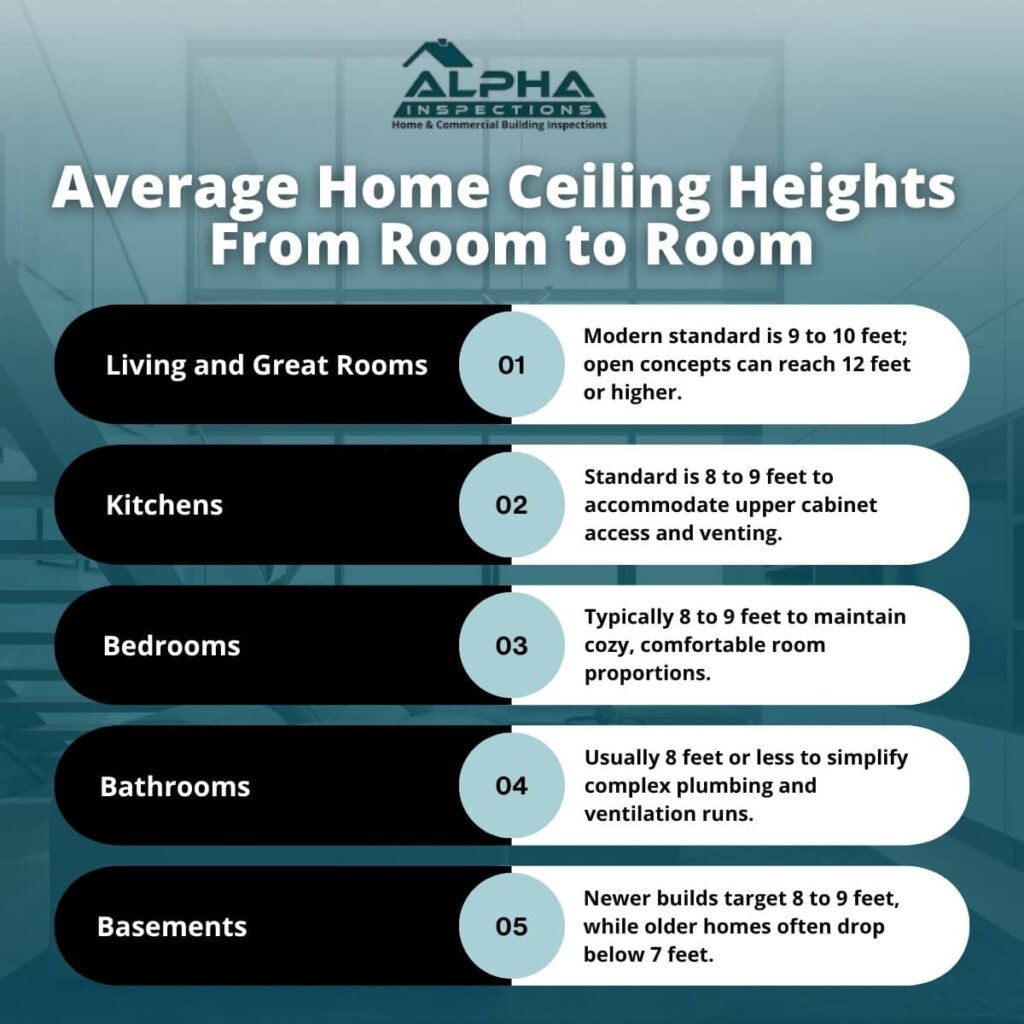
Living rooms typically run 9 to 10 feet in modern homes, and open-concept great rooms sometimes reach 12 feet or higher.
This is where you are most likely to find vaulted or cathedral ceilings, which angle up toward the roofline rather than running flat.
Bedroom
Bedrooms usually stay at 8 to 9 feet. Since bedrooms are private, smaller spaces, the priority is comfort and proportionality rather than grandeur. A room that is 12 feet tall with a standard bed and dresser can feel oddly cavernous.
Kitchen
Kitchens run 8 to 9 feet in most homes. If you go higher, you need to think about cabinet height.
Standard kitchen cabinets top out around 8 feet, so a 10-foot ceiling leaves a gap that collects dust and is hard to reach.
Basement
Basements are where ceiling height problems show up most often during inspections. Older New England homes frequently have basement ceilings of 7 feet or less, which can disqualify the space as a legal habitable area under code.
Newer builds often target 8 to 9 feet to allow for finished basement living space.
Bathroom
Bathrooms are typically 8 feet or less. The smaller square footage means proportions work even with a lower ceiling, and keeping the ceiling height modest simplifies plumbing and ventilation runs.
Why Did Ceiling Heights Change Over Time?
Ceiling height is not just an aesthetic choice. It has followed the materials, energy costs, and lifestyle shifts of each era.
Old Homes: Pre-1960s
Many older homes in New Hampshire, Massachusetts, and Maine were built with variable ceiling heights that reflected the room’s purpose and the era’s priorities. Formal parlors and entryways sometimes ran 10 to 12 feet, while upper floors, servant quarters, and attic rooms dropped to 7 feet or below.
Before central heating and cooling, tall ceilings in main rooms helped heat rise away from people in summer. Smaller rooms upstairs were cheaper and easier to heat.
Post-War Era: 1940s to 1980s
The post-war building boom pushed toward 8-foot flat ceilings as the national standard. The energy crisis of the 1970s reinforced this.
Shorter ceilings meant less air volume to heat and cool, which mattered enormously when fuel costs spiked. Homes from this era have some of the most uniform ceiling heights you will encounter.
Modern Construction: 1990s to Now
Once energy efficiency improved through better insulation and HVAC systems, builders could raise ceilings again without a big cost penalty. Nine-foot ceilings became the market expectation for new construction. Homebuyers started associating taller ceilings with quality and space, so builders delivered.
Today, 10-foot first-floor ceilings are common in custom builds, and some spec homes push even higher in main living areas.
What Does Ceiling Height Tell an Inspector?
Ceiling height itself is not a pass-or-fail item in a home inspection, but what is happening at the ceiling often is.
Our inspectors at Alpha look beyond the measurement and focus on what the ceiling condition reveals about the home.
Signs of Structural Concerns
Cracks, sagging, and separation from walls can all show up in homes with unusual ceiling heights. In older homes with higher ceilings, long unsupported spans are more common, which creates more opportunity for settling-related cracking.
For a deeper look at what ceiling cracks actually mean, see our guide on how bad ceiling cracks are and when to act.
A large crack that runs along a ceiling seam in a post-war home with 8-foot ceilings is usually a drywall tape failure. A diagonal crack near a corner in a 100-year-old home with 10-foot plaster ceilings can point to foundation movement. Context matters.
Insulation and Energy Efficiency Red Flags
Taller ceilings mean more air volume to condition. If a home has 10-foot ceilings and inadequate attic insulation, heating and cooling costs will reflect it.
Inspectors check attic insulation depth and type during every inspection. This is one of the most direct ways ceiling height interacts with energy performance.

Related Questions to Explore
What is the minimum legal ceiling height? The minimum ceiling height for a habitable room under the IRC is 7 feet. Non-habitable spaces like bathrooms can go as low as 6 feet, 8 inches. Local codes in NH, MA, and ME may set higher minimums, so always verify with your municipality if a basement or bonus room is being classified as livable space.
Does ceiling height affect home value? Yes, generally. Taller ceilings are associated with newer construction and are often listed as a selling feature. Homes with 9-foot or higher ceilings tend to sell faster and at higher prices in competitive markets. That said, a home with beautiful 7-foot ceilings in a historic New England farmhouse is not necessarily penalized: buyers in that segment often expect it.
Can you raise a low ceiling? Sometimes. Whether you can raise a ceiling depends on the structural configuration above it. In homes with a floor above, raising the ceiling means reworking joists. In single-story homes or rooms directly under the roof, it may be more feasible. It is an expensive project in either case. A professional inspector can tell you what is above the ceiling before you plan a renovation. For a related look at what goes into a ceiling fan installation and clearance requirements, see our post on how ceiling fans are measured.
Does ceiling height matter during a home inspection? It matters indirectly. Inspectors note ceiling height in basement and attic areas where code minimums apply. More importantly, the ceiling surface itself is inspected for cracks, water stains, sagging, and separation that could signal structural or moisture problems. A ceiling that is any height but shows active water staining is a bigger issue than a ceiling that is 7 feet and clean.
When to Call a Professional
If you are buying a home and ceiling height is raising questions, an inspection is the right next step. This is especially true if:
- The listing mentions a finished basement or bonus room, and you want to confirm it meets habitable ceiling height under code
- You notice ceiling cracks, sagging, or separation from walls during a walkthrough
- You are comparing an older New England home to a newer build, and want to understand what you are dealing with structurally
- A renovation plan involves raising or modifying ceilings, and you need to know what is above them first
Alpha Building Inspections serves NH, MA, and ME with certified inspectors who have completed over 11,000 inspections. We review ceiling conditions as part of every standard home inspection and explain what we find in plain language.
Schedule online and save $25 with code SAVE25.
Conclusion
Ceiling height varies more than most buyers realize. Here is a quick summary:
- Most homes run 8 to 9 feet, with older homes often lower and new builds pushing toward 10 feet
- The legal minimum for a habitable room is 7 feet under the IRC, but local codes can be stricter
- What inspectors care about is not just the height but what the ceiling surface reveals: cracks, water stains, and sagging all tell a story
If you are buying a home in New Hampshire, Massachusetts, or Maine and want to know exactly what you are getting into, Alpha Building Inspections can help.